
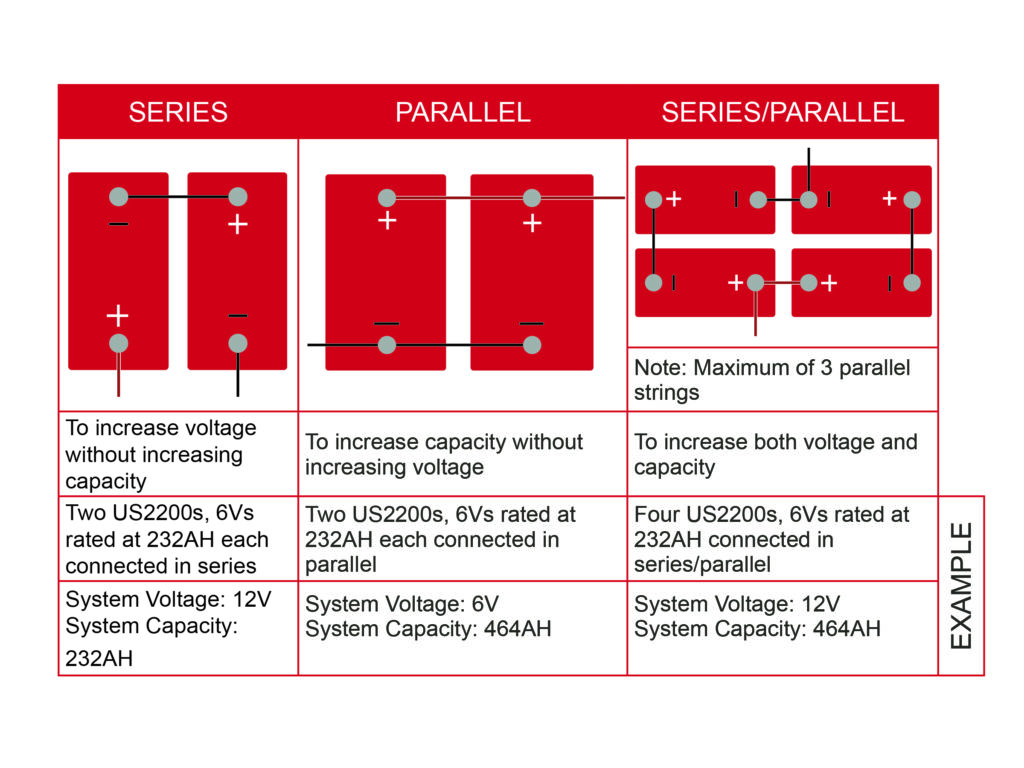
Many battery-powered vehicles and equipment utilize more than one deep-cycle battery to power a 12V, 24V, or 48-volt system. In these instances, connecting the batteries in different ways, either in Parallel or Series, can change the outcome of the battery pack’s voltage or overall capacity.
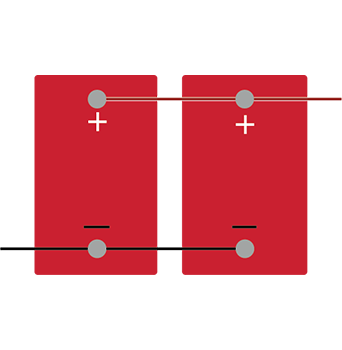
CONNECTIONS IN PARALLEL:
Batteries connected in parallel increase the total amp-hour capacity (runtime) of the battery bank while keeping the operating voltage the same. For example, two 12V 100 amp-hour (Ah) deep-cycle batteries wired in parallel produce a 12-volt, 200 Ah battery bank.
Best Use:
Applications where a golf car requires a particular voltage, but additional amperage provides longer-lasting power between charges.
CONNECTIONS IN SERIES:
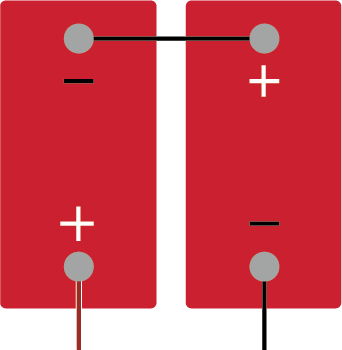
Batteries that are connected in Series increases the total voltage of the battery bank while keeping the amp-hour (Ah) capacity identical to that of a single battery. As an example, a 24V system can use two 12V or four 6V batteries but still maintain the 100 Ah capacity of a single battery.
Best Use:
Spreading voltage across multiple batteries reduces current draw (amperage) through the wires and can provide greater efficiency over longer distances.
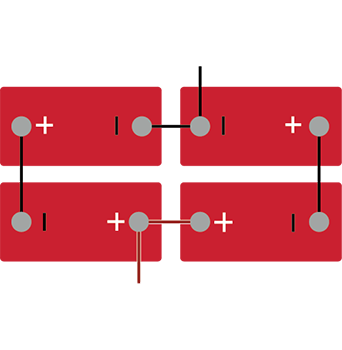
CONNECTIONS IN SERIES/PARALLEL:
When you connect batteries in series and parallel, you increase both total voltage and capacity (runtime). As an example, four 12V 100Ah batteries in a 24V system are connected in Series to create two 24V 100Ah battery banks. The two banks are connected in Parallel, to make a 24V 200Ah battery bank. Please note that connecting batteries in series and parallel can easily increase a battery bank’s total power. However, this configuration introduces significant complexity regarding battery charging and consistency. Be sure to consult the battery manufacturer about the restrictions before setting up these connections.
*Note: Maximum of 3 parallel strings
Safety Precautions:
Check The Connections: Ensure that the terminal cable bolts and wiring mounts are tight. Battery manufacturers have a recommended torque setting for tightening the bolts holding terminal cables. Check with the battery manufacturer to know what torque settings are correct for your deep-cycle battery.
Batteries Being Connected Should Be Identical. Make sure to connect the same battery chemistries together (Lithium-ion, Flooded Lead-Acid, AGM).
Use Same Size Cables: All connections should utilize the same size battery cables recommended by the battery manufacturer to ensure proper amperage flow.
- Consult with Battery Manufacturer regarding their recommended connections.
For more information on various deep-cycle battery connections, visit our Configurations Page